Your location:
 /
valves
/
Gate Valve
/
Fire Gate Valve
/
Z45X Hidden Stem Fire Gate Valve
/
valves
/
Gate Valve
/
Fire Gate Valve
/
Z45X Hidden Stem Fire Gate Valve

Mark Classification of Fluid products
- Phone:+86(577)67198981
- Fax:+86(577)67038872
- mobile:+8613388552747
- Sales Email 1:Karrie@shanliuvalve.com
- Sales Email 2:Yannie@shanliuvalve.com
- Sales Email 3:Merry@shanliuvalve.com
- Sales Email 4:Lucas@shanliuvalve.com
- Email:sales@shanliuvalve.com

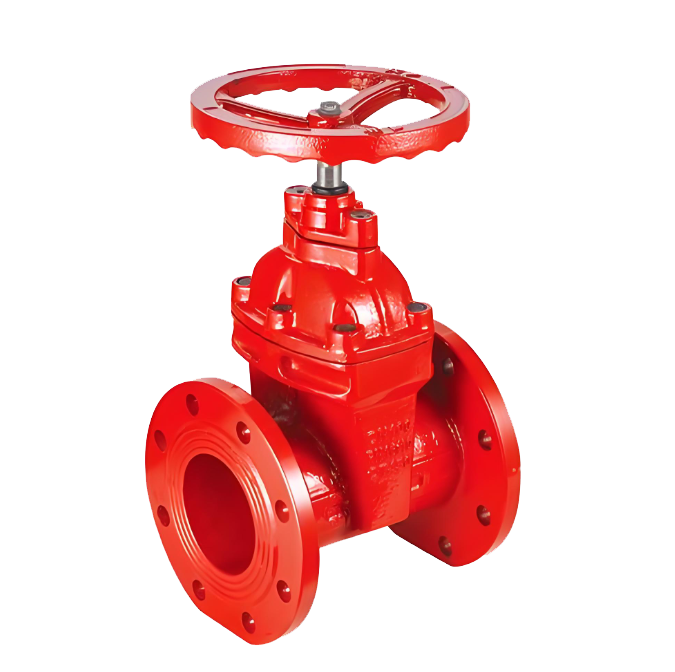
Z45X Hidden Stem Fire Gate Valve
- Model:Z45X-10/Z45X-16/Z45X-16Q/Z45X-25/Z45X-25Q/Z45X-16P/Z45X-25P/Z45X-16T/Z45X-25T
- Specification:DN50~DN400mm
- Temperature:≤80℃
- Medium: water, and media similar to water.
- Pressure:PN10-PN25
- Connection method:Flange
- Driving method:manual, Electric, Pneumatic
- Material:Cast Iron, Ductile Iron, Stainless Steel


Add QR code to serve you!
- Product Overview
- Performance Data
- Size Weight
Overview
The Z45X Hidden-Stem Fire Gate Valve is a core control device specifically designed for modern fire protection water supply systems. Featuring a non-rising stem and an integral rubber-lined gate plate structure, it employs internal threaded transmission within the stem to drive vertical movement of the gate plate, ensuring reliable pipeline opening and closing. Strictly compliant with GB/T 12234 and China Compulsory Certification for Fire Protection Products (CCCF) standards, this valve integrates a mechanical signal feedback device. It converts the valve's open/closed status into real-time electrical signals transmitted to the fire control center, ensuring the fire protection pipeline network remains in a legally mandated standby state at all times. Its compact concealed-stem design is particularly suited for installation in space-constrained fire pipe shafts and pump rooms. Specifically designed for various building fire protection systems, including fire hydrant systems, automatic sprinkler systems, and fire pump room pipelines, it serves as a critical control device ensuring the reliable operation of fire water supply systems.
Z45X Hidden Stem Fire Gate Valve Product Diagram
Features
1. Fire Alarm Feedback: Built-in microswitch outputs electrical signals to the fire control room when the valve is fully open/closed, enabling remote status monitoring.
2. Full Rubber-Lined Sealing: The gate plate is fully covered with rubber for tight sealing, achieving zero leakage in both directions and extended service life.
3. Concealed-Stem Compact Design: Non-rising stem saves installation space, ideal for confined locations like fire wells.
4. Fire-Rated Corrosion Protection: Epoxy-coated interior and stainless steel critical components resist corrosion in long-term static water environments.
5. Dual-Operation Assurance: Supports standard manual operation and emergency power-fail operation, ensuring reliable opening/closing at all times.
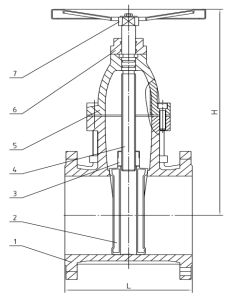
Z45X Hidden Stem Fire Gate Valve Structural Diagram
Parts Name and Material List
| Serial No | Part Name | Material |
| 7 | Handwheel | Carbon Steel |
| 6 | Gland | Ductile Iron |
| 5 | Bonnet | Ductile Iron |
| 4 | Stem | Chromium Stainless Steel |
| 3 | Stem Nut | Copper Alloy |
| 2 | Gate | Ductile Iron |
| 1 | Body | Ductile Iron |
Performance Specification Table
| Performance Specification Table | ||
| Nominal Pressure | 1.6 | MPa |
| Strength Test Pressure | 2.4 | |
| Seal Test Pressure | 1.76 | |
| Operating Temperature | ≤80 | ℃ |
Dimensioning Standards
1. Structural length of valves shall comply with GB/T 12221.
2. Connecting flanges shall comply with GB/T 17241.6.
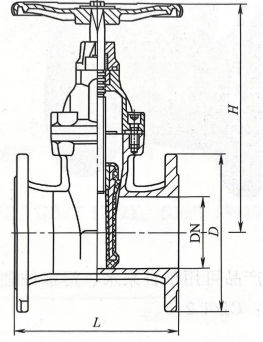
Z45X Hidden Stem Fire Gate Valve Outline Drawing
Outline dimension table
| Dimension Chart | Dimensions | Nominal size DN | |||||||||||||||||
| 50 | 65 | 80 | 100 | 125 | 150 | 200 | 250 | 300 | 350 | 400 | 450 | 500 | 600 | 700 | 800 | 900 | 1000 | ||
| Z45X-10Q Z45X-16Q | L | 178 | 190 | 203 | 229 | 254 | 267 | 292 | 330 | 356 | 381 | 406 | 432 | 457 | 508 | 610 | 660 | 711 | 811 |
| D | 165 | 185 | 200 | 220 | 250 | 285 | 340 | 395 | 445 | 505 | 565 | 615 | 670 | 780 | 895 | 1015 | 1115 | 1230 | |
| H | 226 | 252 | 290 | 330 | 420 | 440 | 542 | 639 | 725 | 833 | 987 | 1018 | 1127 | 1403 | 1685 | 1994 | 2610 | 2770 | |
-
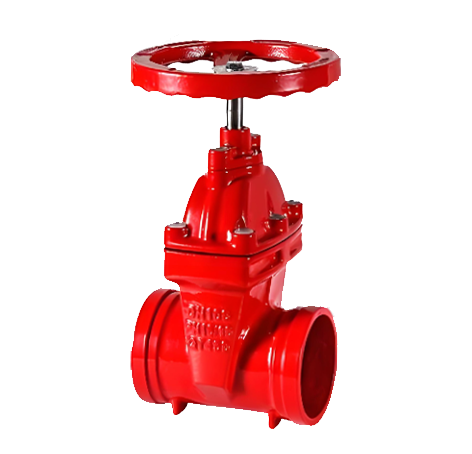 Z85X groove non-rising stem fire gate valve
Model:
Z85X-10/Z85X-16Q/Z85X-25Q/Z85X-16P/Z85X-25P/Z85X-16R/Z85X-25RSpecification:
DN50-DN200Pressure:
PN10-PN16Material:
cast iron, ductile iron, stainless steel -
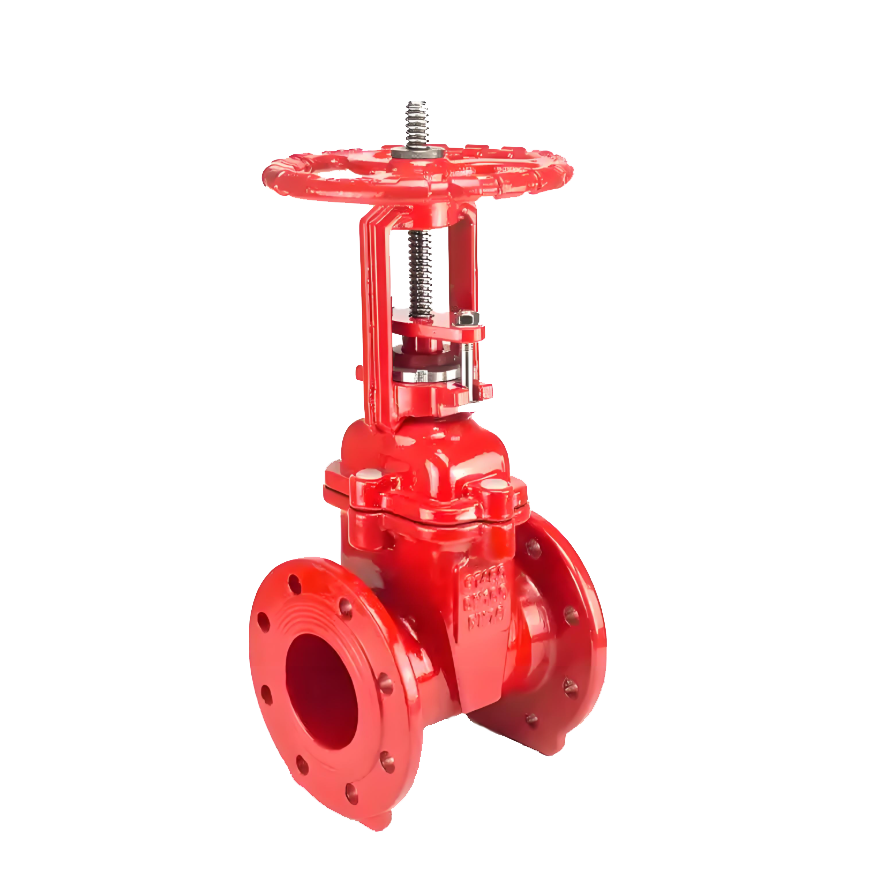 Z41X Rising Stem Fire Gate Valve
Model:
Z41X-10/Z41X-16Q/Z41X-25Q/Z41X-16P/Z41X-25P/Z41X-16R/Z41X-25RSpecification:
DN50-DN800Pressure:
PN10-PN25Material:
cast iron, ductile iron, stainless steel -
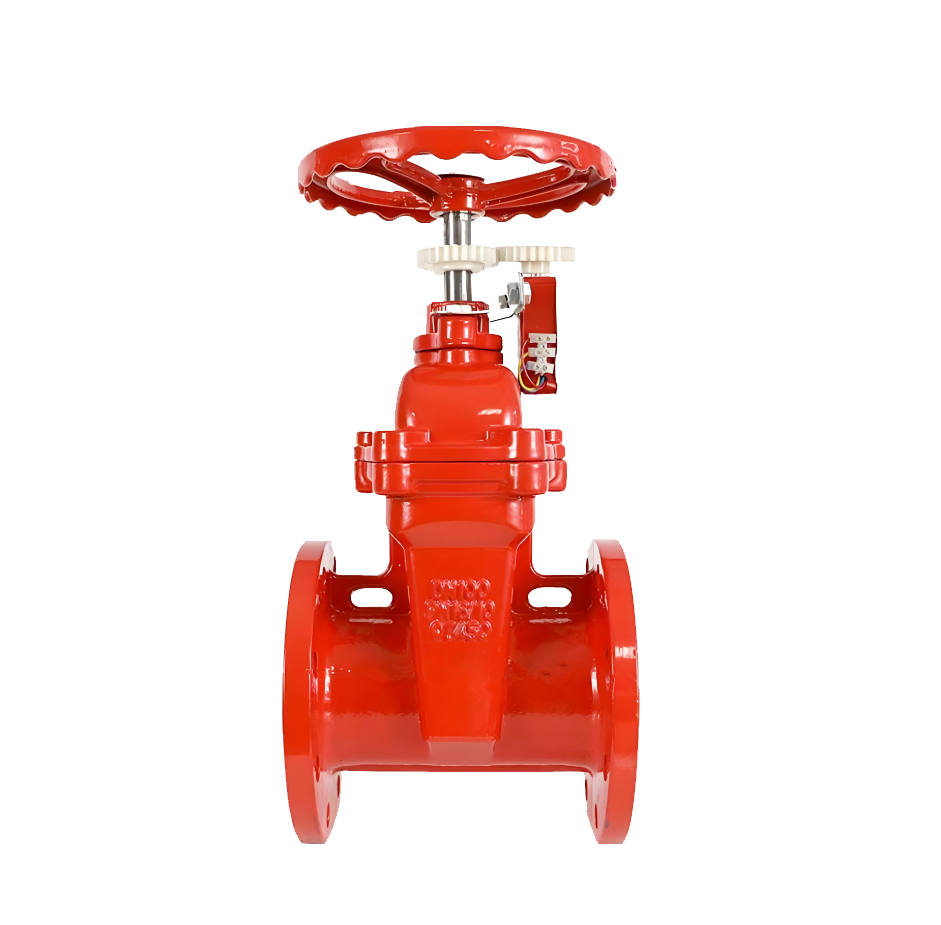 Z45X fire signal gate valve
Model:
XZ45X-10/XZ45X-16Q/XZ45X-25Q/XZ45X-16P/XZ45X-25P/XZ45X-16R/XZ45X-25RSpecification:
DN50-DN400Pressure:
PN10-PN16Material:
cast iron, ductile iron, stainless steel

What are the structural characteristics of knife gate valves? A detailed explanation of their six major advantages and application areas
Description: This article provides a detailed analysis of the unique structure, six core characteristics, and working principle of knife gate valves. It explains how they achieve automatic control through accessories and are widely used in industries such as chemical, paper, and wastewater treatment. They are ideal sealing and throttling valves.
Text:
The knife gate valve, as a high-performance industrial valve, is widely used in various fields such as chemical industry, coal, sugar manufacturing, sewage, paper making, etc., due to its unique structure and excellent performance. It is particularly suitable for regulating, throttling, and cutting off media in pipelines. This article will provide an in-depth analysis of the structural composition and core characteristics of the knife gate valve.
I. Basic Structure and Working Principle of Knife Gate Valve The knife gate valve is primarily composed of left/right valve bodies, U-shaped sealing rings, gate plates, valve stems, brackets, and driving devices (such as cylinders). Its core opening and closing actions are typically driven by cylinders. With supporting accessories such as solenoid valves and proximity switches, it can easily achieve on-off control, signal feedback, or continuous automatic adjustment, demonstrating a high degree of automation integration.
II. Six Core Structural Features of Knife Gate Valves The excellent performance of knife gate valves stems from their carefully designed structure, which is mainly reflected in the following six aspects:
The wafer-style design is compact and lightweight. Utilizing an advanced wafer-style connection structure, it significantly reduces the volume and weight compared to traditional flange valves, saving installation space and reducing the load on the pipeline system.
The full-bore flow passage provides a completely open straight-through channel when the non-clogging valve is opened, allowing the medium to pass through unimpeded. This design effectively prevents the deposition and clogging of media such as slurry and particles within the valve body, making it particularly suitable for applications involving fibers or solid particles, such as in paper making and wastewater treatment.
U-shaped seal ring, excellent sealing performance. A specially designed elastic U-shaped seal ring is used as the main seal, which can adaptively compensate for wear, ensuring that the valve maintains good bidirectional sealing performance and low leakage rate even after long-term use.
The elastic valve seat facilitates the maintenance of the gate plate's external seal, which is achieved by an elastic sealing strip embedded in the valve body. This sealing strip can be adjusted or quickly replaced using screws and a pressure plate, making maintenance simple and greatly extending the service life of the valve while reducing maintenance costs.
Streamlined design ensures minimal flow resistance. Due to the straight and smooth channels, as well as the thin and sharp gate plate (shaped like a blade), the flow resistance experienced by the medium is negligible, contributing to a reduction in system energy consumption.
Modular structure, convenient for installation and maintenance. The overall structure is designed to be simple and highly modular, making installation, disassembly, and routine maintenance very convenient, significantly reducing downtime for maintenance.
III. Summary of Application Scenarios Due to its prominent features of anti-clogging, easy adjustment, good sealing, and low flow resistance, the knife gate valve has become an ideal choice for handling harsh working conditions such as viscous media, slurry, dust mixtures, and sewage. It plays an irreplaceable key role in pulp adjustment in the paper industry, material liquid transportation in the chemical industry, emission control in sewage treatment plants, and solid material pipelines in industries such as coal and sugar manufacturing.
In summary, the knife gate valve is a valve solution that highly combines practicality, reliability, and economy. Its innovative structural design directly addresses common pain points in industrial applications, making it an indispensable and important component in modern process industry pipeline systems.
Rewriting instructions:
Enhance title and keyword layout: Optimize the title according to SEO requirements, extract core keywords such as "structural features", "advantages", and "application areas", and distribute them reasonably.
Optimize content structure and hierarchy: Adjust the segmentation of the original text, adopt hierarchical headings and bullet points, and enhance the coherence and readability of the information.
Supplementary induction and summary of applicable scenarios: Add a summary paragraph to highlight the comprehensive value of the product, enhancing the depth of content and user reference value.
If you prefer a more lively or technical document style, I can continue to optimize and adjust it for you.

Address:No. 1, Linxia Road, Sanqiao Industrial Zone, Oubei Sub-district, Yongjia County, Zhejiang Province| Switchboard:0577-67198981| mobile:+8613388552747| Email:sales@shanliuvalve.com|
COPYRIGHT © Zhejiang Shanliu Valve Technology Co., Ltd. Main Business: Water Valve Industrial valve|
浙ICP备2026020749号