Your location:
 /
valves
/
More water supply and drainage valves
/
Balancing Valve
/
SP15F Static Balancing Valve
/
valves
/
More water supply and drainage valves
/
Balancing Valve
/
SP15F Static Balancing Valve

Mark Classification of Fluid products
- Phone:+86(577)67198981
- Fax:+86(577)67038872
- mobile:+8613388552747
- Sales Email 1:Karrie@shanliuvalve.com
- Sales Email 2:Yannie@shanliuvalve.com
- Sales Email 3:Merry@shanliuvalve.com
- Sales Email 4:Lucas@shanliuvalve.com
- Email:sales@shanliuvalve.com

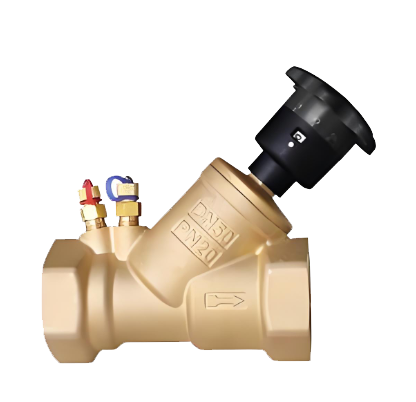
SP15F Static Balancing Valve
- Model:SP15F-10T/SP15F-16T/SP15F-25T
- Specification:DN50-DN300
- Temperature:≤80℃
- Medium:Water and similar media
- Pressure:PN10~25
- Connection method:Threaded
- Driving method:Manual
- Material:Copper


Add QR code to serve you!
- Product Overview
- Performance Data
- Size Weight
A static balancing valve is a hydraulic balancing device used for manual adjustment and setting in fluid pipeline systems (primarily HVAC and centralized heating water systems). By manually adjusting the valve core opening, it modifies local resistance to precisely distribute and lock the flow in each parallel branch. This valve lacks automatic regulation capability during operation, with its set values remaining fixed after initial system commissioning. It primarily eliminates inherent static hydraulic imbalances in the system, ensures accurate distribution of design flow rates, and serves as a fundamental component for achieving system energy efficiency and operational stability.
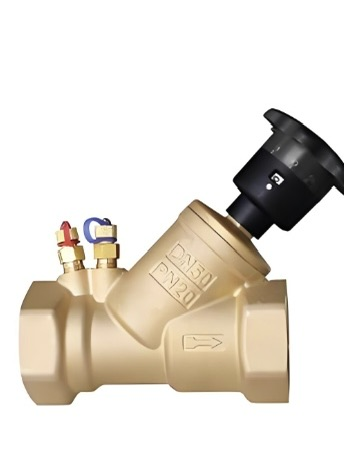
Static Balancing Valve Product Diagram
Feature
1. Preset and Locking Function: The valve features precise opening indication scales and a reliable mechanical locking mechanism. Operators can adjust the valve and lock the opening according to the design flow rate, effectively preventing preset value changes caused by misoperation or vibration, ensuring the system remains in a balanced state over the long term.
2. Measurement capabilities and quantitative debugging: The valve body integrates a dedicated measuring nozzle that connects to smart instruments, enabling real-time measurement of flow rate, pressure differential, and temperature through the valve without affecting its operational status. This transforms system debugging from empirical judgment to data-driven quantification, significantly improving both precision and efficiency.
3. Excellent regulation performance: Featuring a valve core design with linear or isobaric flow characteristics, it ensures high regulation linearity. The system provides a wide range of KV values or preset openings, enabling precise and smooth regulation across a broad flow range.
4. Shut-off function and low flow resistance: The valve exhibits excellent sealing performance in the fully closed position, making it suitable as a pipeline shut-off valve. When fully open, the optimized flow channel design results in an extremely low resistance coefficient, minimizing unnecessary energy consumption in system transportation.
5. Wide application and stable reliability: The robust structure requires no external power and is suitable for various scenarios requiring one-time hydraulic balance setting, such as fan coil units, radiator branches, and thermal inlet systems. It features a purely mechanical structure with low failure rate and minimal maintenance requirements.
Static Balancing Valve Structure Diagram
List of Component Names and Materials
| Part Name | Common materials |
| body,cover,disc, packing gland | copper |
| disc、spring | stainless steel |
| stem nut | cast copper |
| washer | rubber-asbestos plate |
| packing | expanded graphite |
Performance Specification Sheet
| Performance Specification Sheet | ||||
| Nominal Pressure | 1.0 | 1.6 | 2.5 | MPa |
| Strength test pressure | 1.5 | 2.4 | 3.8 | |
| Sealing test pressure | 1.1 | 1.76 | 2.8 | |
| Applicable Temperature | ≤80 | ℃ | ||
Standard requirements for external dimensions
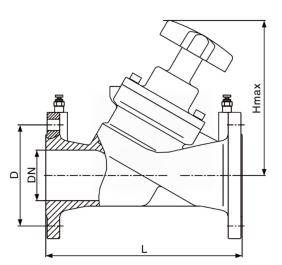
1. The structural length of the valve shall comply with the standard of GB/T12221
Static Balancing Valve Outline Diagram
Outline Dimension Sheet
| Nominal diameter (mm) | Key Dimension | ||
| D | L | H | |
| 50 | 165 | 215 | 250 |
| 65 | 185 | 240 | 300 |
| 80 | 200 | 280 | 320 |
| 100 | 220 | 310 | 330 |
| 125 | 250 | 355 | 350 |
| 150 | 285 | 400 | 500 |
| 200 | 340 | 465 | 570 |
| 250 | 405 | 550 | 660 |
| 300 | 460 | 600 | 750 |
-
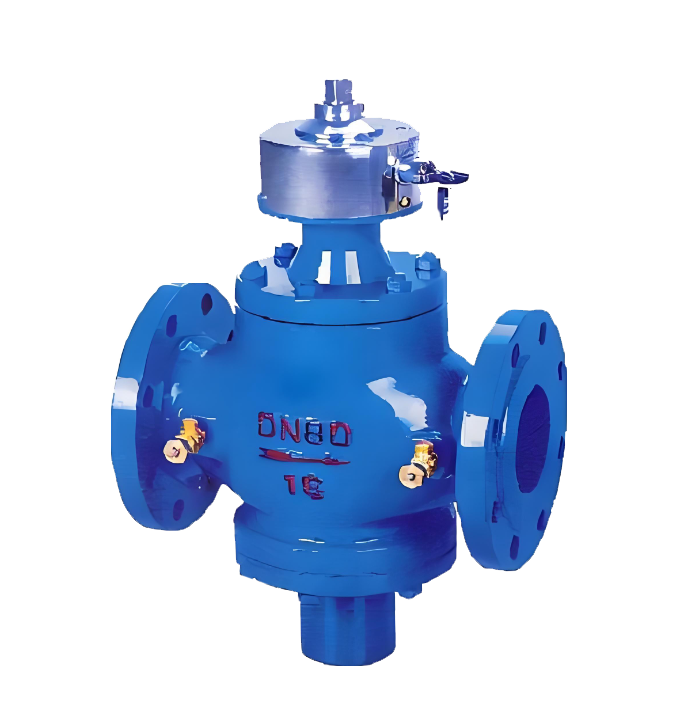 ZL47F Self Operated Flow Balancing Valve
Model:
ZL47F-10/ZL47F-16/ZL47F-10Q/ZL47F-16Q/ZL47F-25Q/ZL47F-10P/ZL47F-16P/ZL47F-25PSpecification:
DN15-DN350Pressure:
PN10~PN25Material:
cast iron, ductile iron, stainless steel -
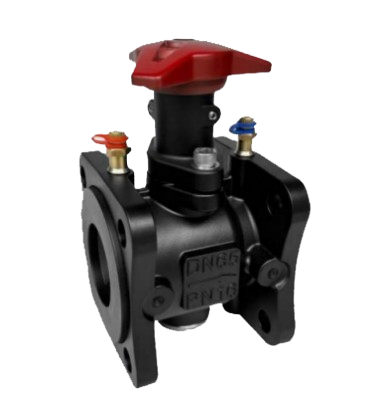 PWQ47F High Performance Balancing Valve
Model:
PWQ47F-16Q/PWQ47F-16PSpecification:
DN40-DN200Pressure:
PN16Material:
Ductile iron, Stainless steel -
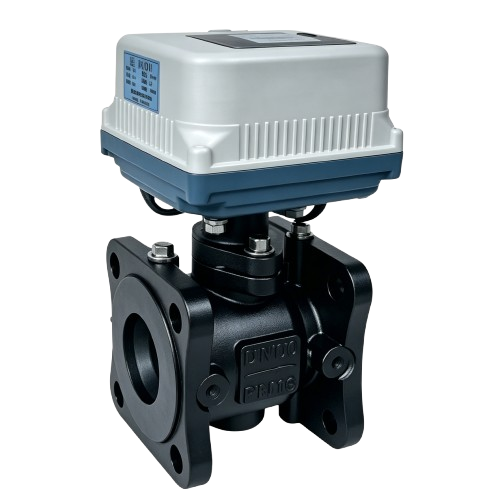 PWQ947F High-Performance Pressure-Balanced Balancing Valve
Model:
PWQ947F-16Q/PWQ947F-16PSpecification:
DN40-DN200Pressure:
PN16Material:
Ductile iron, Stainless steel

Address:No. 1, Linxia Road, Sanqiao Industrial Zone, Oubei Sub-district, Yongjia County, Zhejiang Province| Switchboard:0577-67198981| mobile:+8613388552747| Email:sales@shanliuvalve.com|
COPYRIGHT © Zhejiang Shanliu Valve Technology Co., Ltd. Main Business: Water Valve Industrial valve|
浙ICP备2026020749号