Your location:
 /
valves
/
Pressure Reducing Valve
/
Water Pressure Reducing Valve
/
Y41X Adjustable Pressure Reducing Valve
/
valves
/
Pressure Reducing Valve
/
Water Pressure Reducing Valve
/
Y41X Adjustable Pressure Reducing Valve

Mark Classification of Fluid products
- Phone:+86(577)67198981
- Fax:+86(577)67038872
- mobile:+8613388552747
- Sales Email 1:Karrie@shanliuvalve.com
- Sales Email 2:Yannie@shanliuvalve.com
- Sales Email 3:Merry@shanliuvalve.com
- Sales Email 4:Lucas@shanliuvalve.com
- Email:sales@shanliuvalve.com

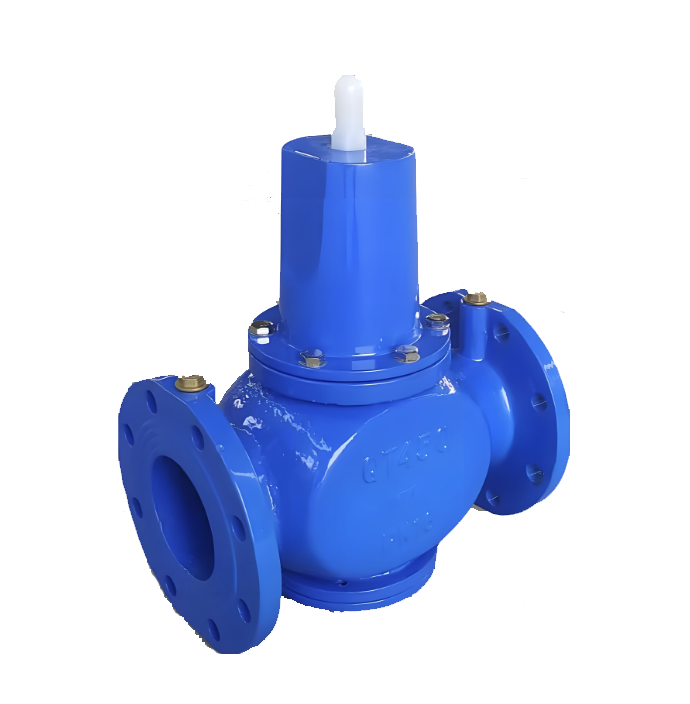
Y41X Adjustable Pressure Reducing Valve
- Model:Y41X-16/Y41X-25/Y41X-16C/Y41X-25C
- Specification:DN125-DN400
- Temperature:≤80℃
- Medium:Water and liquids with properties similar to water
- Pressure:PN16,PN25
- Connection method:Flange
- Driving method:spring
- Material:Cast iron、ductile iron、carbon steel


Add QR code to serve you!
- Product Overview
- Performance Data
- Size Weight
Y41X Adjustable Pressure Reducing Valve Overview
The Y41X Adjustable Pressure Reducing Valve is a precision hydraulic control valve integrating pilot control and main valve linkage, specifically designed for medium and high-pressure pipeline systems requiring extremely high pressure stability. It senses and amplifies the downstream pressure signal through the pilot valve, and precisely drives the main valve disc to act hydraulically. This automatically and smoothly reduces the high, unstable inlet pressure to the user-preset outlet pressure value and locks it in. Its core function is to achieve precise pressure stabilization under conditions of large flow and high pressure difference, effectively eliminating pipeline network pressure fluctuations and protecting the safety of downstream equipment. Adopting flange connection, the valve is usually made of ductile iron or stainless steel as the main material. It is widely used in the main pipelines of high-rise building water supply, district water supply networks, fire protection systems, industrial circulating water and large-scale irrigation systems, serving as the core equipment for system pressure zoning and control.
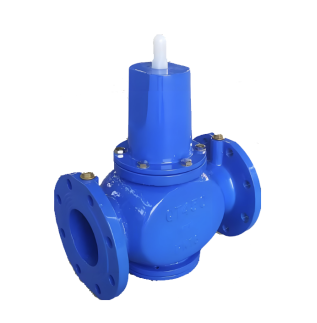
Y41X Adjustable Pressure Reducing Valve Product Image
Y41X Adjustable Pressure Reducing Valve Features
1. Pilot Control, Precise Pressure Stabilization Adopts a hydraulic linkage structure with separate pilot valve and main valve. Acting as an "intelligent controller," the pilot valve highly sensitively senses downstream pressure changes and drives the main valve piston or diaphragm through the control pipeline, enabling large-stroke, smooth opening and closing of the main valve disc. This design provides strong compensation capability for inlet pressure fluctuations and flow changes, delivering high outlet pressure control precision—far superior stability compared to direct-acting pressure reducing valves.
2. Wide Adjustable Range, Strong Adaptability Equipped with a wide-range, high-precision pressure adjustment mechanism. Within the valve’s rated operating range, users can continuously and linearly set the required outlet pressure by adjusting the adjusting screw on the pilot valve. The wide adjustment range meets various pressure demands of different zones or equipment, ensuring broad adaptability.
3. Flange Connection, Abundant Flow Capacity Features standard flange connection (e.g., PN16/PN25) with a large diameter range (commonly DN50 and above). The optimized flow channel design minimizes fluid resistance, meeting the high-flow requirements of main pipelines while maintaining stable pressure reduction. It boasts low pressure drop loss and significant energy-saving effects.
4. Self-Cleaning Design, Reliable Operation The main valve disc typically adopts a piston-like structure, which achieves self-cleaning during opening and closing to effectively prevent impurity deposition and jamming. The pilot control circuit is usually equipped with a built-in filter screen to protect the precision pilot valve from pipeline impurities, ensuring long-term reliable and maintenance-free operation even in complex water quality conditions.
5. Multi-Functional, High Integration In addition to the core pressure reducing and stabilizing functions, it usually integrates pressure relief and retention capabilities. When the downstream pressure abnormally rises beyond the safe set value, the valve automatically opens to relieve pressure; it can also be adjusted to pressure retention mode when maintaining the minimum pipeline pressure is required. Some models offer optional pressure gauge interfaces for intuitive pressure monitoring, achieving high functional integration.
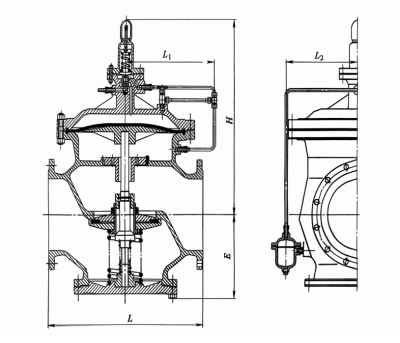
Y41X Adjustable Pressure Reducing Valve Structure Diagram
Parts Name Material List
| 序 号NO. | 名称Name | 材料Material |
| 1 | 阀体body | 铸铁 cast iron |
| 2 | 阀盖bonnet | 铸铁 cast iron |
| 3 | 阀瓣弹簧dics spring | 铬钒钢chromium-vanadium steel |
| 4 | 调节弹簧regulating spring | 硅锰钢silicon-manganese steel |
| 5 | 膜片diaphragm | 不锈钢Stainless Steel |
| 6 | 活塞环piston ring | 合金耐磨铸铁alloy wear-resistant cast iron |
| 性能规范表Performance Specification | ||
| 公称压力Nominal Pressure | 1.6/2.5 | MPa |
| 强度试验压力Shell Test | 2.4/3.75 | |
| 密封试验压力Seal Test | 1.76/2.75 | |
| 适用温度Suitable Temp. | ≤80 | ℃ |
Dimensions Standard Requirements
1. The structural length of the valve shall conform to the standard GB/T12221.
2. The connecting flange shall conform to the standard GB/T 17241.6
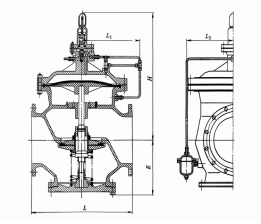
Y41X Adjustable Pressure Reducing Valve View Drawing
Y41X Adjustable Pressure Reducing Valve Dimension Table
| 型号 | 尺寸 | 公称尺寸DN | ||||||
| 125 | 150 | 200 | 250 | 300 | 350 | 400 | ||
| Y41X-16Y41X-16C | L | 400 | 450 | 500 | 600 | 750 | 800 | 800 |
| L | 250 | 270 | 300 | 350 | 435 | 460 | 460 | |
| L₂ | 270 | 290 | 320 | 370 | 455 | 480 | 480 | |
| E | 180 | 180 | 225 | 250 | 349 | 一 | 一 | |
| H | 415 | 415 | 475 | 510 | 820 | 950 | 1050 | |
-
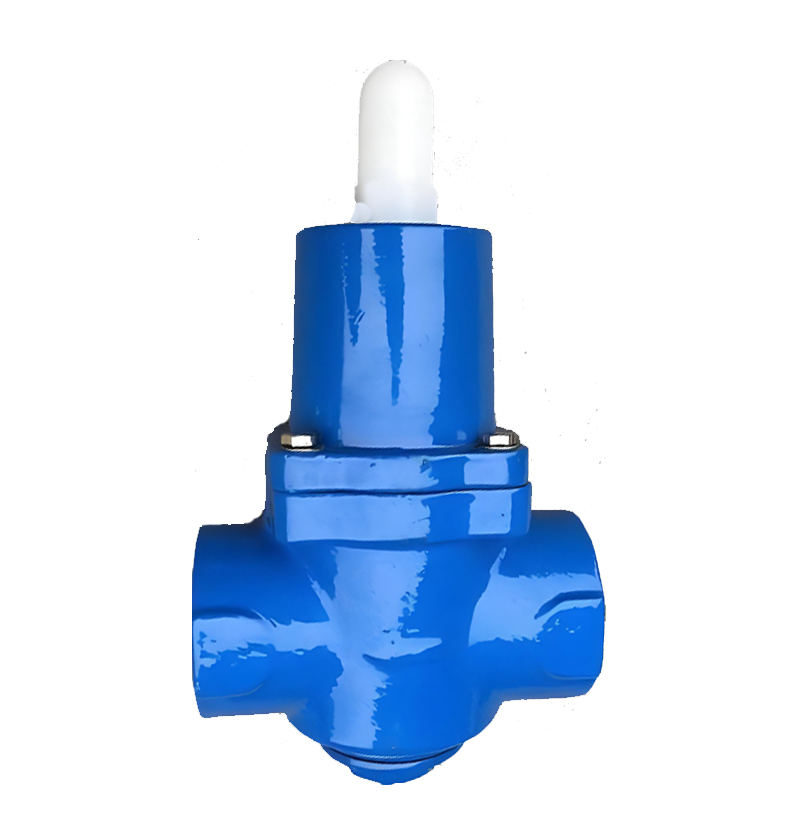 Y11X Direct-Acting NPT Pressure Reducing Valve
Model:
Y11X-10Q/Y11X-16Q/Y11X-10/Y11X-16Specification:
DN15-DN50Pressure:
PN10,PN16Material:
ductile iron、Grey Cast Iron -
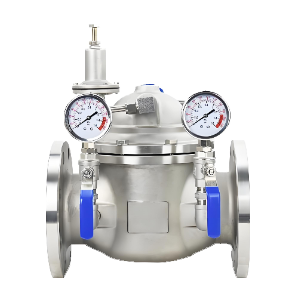 200X Water Pressure Reducing Valve
Model:
200X-10/200X-16/200X-25/200X-10C/200X-16C/200X-25C/200X-10T/200X-16T/200X-25T/200X-10P/200X-16P/200X-25PSpecification:
DN50-DN800Pressure:
PN10,PN16,PN25Material:
Cast Iron、Cast Steel、Stainless Steel、brass -
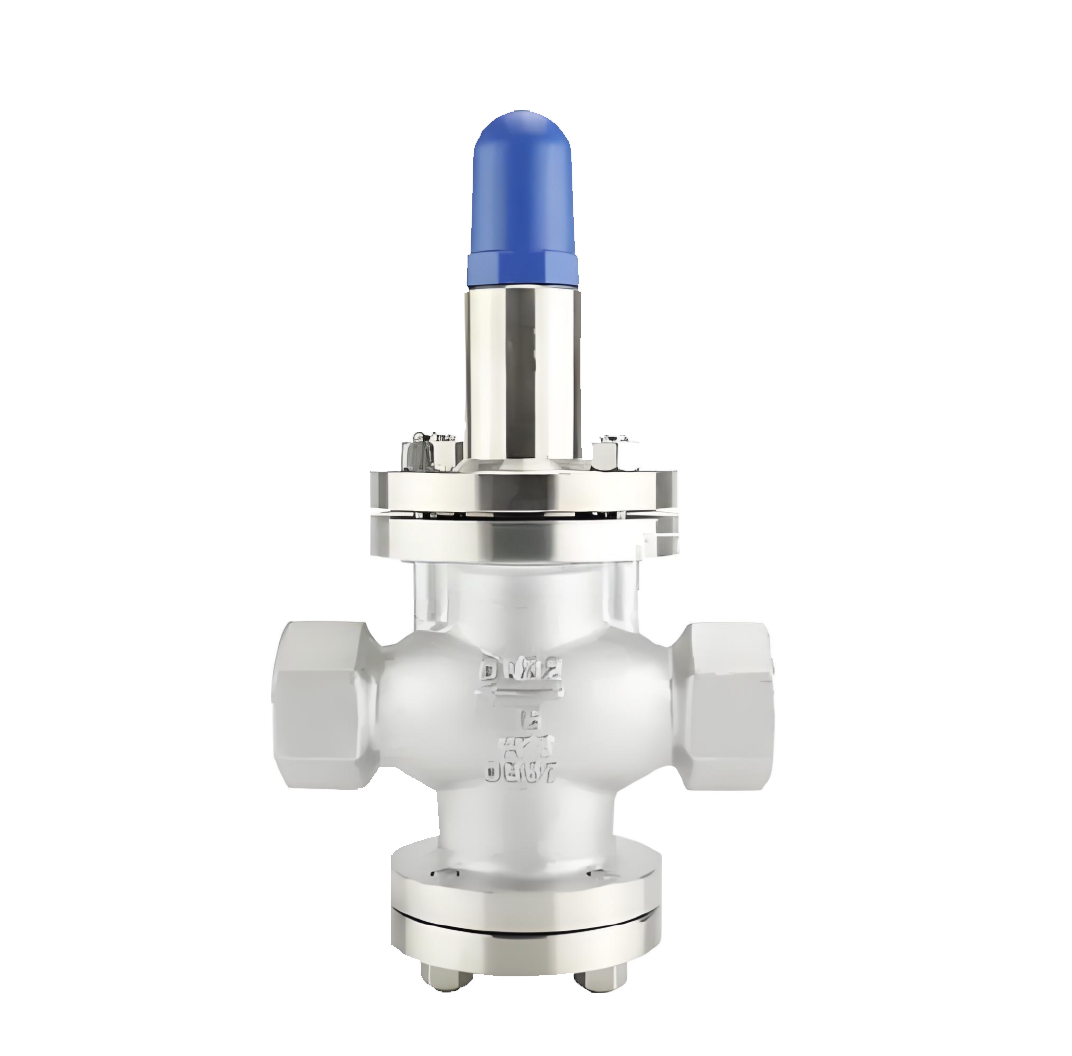 Y12H Diaphragm Stainless Steel Pressure Reducing Valve
Model:
Y12H-16P/Y12H-25PSpecification:
DN15-DN50Pressure:
PN16,PN25Material:
Stainless steel

Is the noise from the pressure reducing valve disturbing? Understand the 3 fundamental reasons and solutions in one article
The harsh noise generated by pressure reducing valves during operation is not only an environmental pollution problem, but also a precursor to equipment failure. This article will delve into the three fundamental causes of noise generated by pressure reducing valves - mechanical vibration noise, fluid dynamics noise, and aerodynamic noise, and provide professional solutions.
1、 Mechanical vibration noise: a test of design and process
Mechanical vibration noise is the most common type of noise in pressure reducing valves, mainly divided into two forms:
1. Low frequency vibration noise
Causes:
Medium jet and pressure pulsation
The outlet flow rate of the valve is too fast
Unreasonable pipeline layout
Insufficient rigidity of moving parts inside the valve
2. High frequency vibration noise (resonance phenomenon)
Causes:
The natural frequency of the valve coincides with the excitation frequency of the medium
Easy to occur within a specific decompression range
Sensitive to changes in working conditions, with significant noise fluctuations
Solution:
Optimize the clearance design between the liner and valve stem
Improve machining accuracy
Adjust the natural frequency of the valve
Enhance the rigidity of active components
Select appropriate damping materials
2、 Fluid Dynamics Noise: Challenges in Fluid Control
The turbulence and eddies generated when the fluid passes through the pressure reducing valve can cause significant noise problems.
1. Turbulent noise
Features: Low frequency, low noise level
Cause: Interaction between turbulent fluid and the inner surface of valves/pipelines
Impact: Usually does not constitute a serious noise problem
2. Cavitation noise (the most harmful)
Production mechanism:
During the depressurization process, the fluid flow velocity reaches the critical value
The liquid begins to vaporize, producing bubbles
Bubble explosion under pressure generates shock waves
Local instantaneous pressure can reach 196 MPa
Key data:
Initial value of Δ p: the critical pressure reduction value at which liquid begins to cavitation
Exceeding this value leads to a sharp increase in noise
Preventive measures:
Control the actual pressure reduction value below the critical value
Optimize the design of valve disc fluid direction
Adopting a multi-stage decompression structure
Choose anti cavitation materials
3、 Aerodynamic noise: characteristics of compressible fluids
When compressible fluids such as steam pass through pressure reducing areas, unique noise issues arise:
Production principle:
Conversion of fluid mechanical energy into sound energy
Interaction between high-speed airflow and valve structure
Sudden pressure changes cause gas expansion and sound emission
Control method:
Optimize the design of pressure reducing flow channels
Using mufflers or diffusers
Control the outlet flow rate
Reasonably set back pressure
Comprehensive solutions and selection suggestions
Preventive measures during the design phase
Parameter optimization: Accurately calculate operating parameters to ensure that the pressure reduction value is within the design range
Structural design: Adopting streamlined flow channels to reduce turbulence generation
Material selection: Select special alloys with high rigidity and cavitation resistance
Frequency analysis: avoid the natural frequency of the valve coinciding with the excitation frequency
Key points for installation and maintenance
Correct installation: Ensure the length of the front and rear straight pipe sections to avoid sharp bends
Regular testing: Establish a noise monitoring mechanism to detect problems early on
Timely maintenance: replace worn parts and maintain the best condition of the valve
Brand selection recommendation
High pressure differential operating condition: choose multi-stage pressure reducing valve
Liquid medium: focus on anti cavitation design
Gas/Steam: Focus on Aerodynamic Optimization
Sensitive environment: Choose a low-noise dedicated model
Professional Technical Summary
The essence of the noise problem of pressure reducing valves is the process of energy conversion and release. Fundamentally, all noise issues are closely related to the rationality of valve design, manufacturing process accuracy, and compatibility with operating conditions. Through scientific selection, correct installation, and standardized maintenance, it is entirely possible to control the noise of the pressure reducing valve within an acceptable range.
Immediate action suggestion: If you are troubled by pressure reducing valve noise, it is recommended to first record the noise characteristics (frequency, time period, change pattern), check whether the operating parameters deviate from the design values, and promptly contact professional technicians for diagnosis and treatment.
Keywords of this article: pressure reducing valve noise, mechanical vibration noise, cavitation noise, fluid dynamics noise, pressure reducing valve failure, valve noise reduction, industrial noise control, equipment maintenance
Extended reading: For more professional knowledge about industrial valve selection and maintenance, please follow our technical column to obtain the latest solutions and industry practice cases.
Address:No. 1, Linxia Road, Sanqiao Industrial Zone, Oubei Sub-district, Yongjia County, Zhejiang Province| Switchboard:0577-67198981| mobile:+8613388552747| Email:sales@shanliuvalve.com|
COPYRIGHT © Zhejiang Shanliu Valve Technology Co., Ltd. Main Business: Water Valve Industrial valve|
浙ICP备2026020749号