Your location:
 /
valves
/
check valve
/
Swing Check Valve
/
HH47X Buffered Butterfly Check Valve
/
valves
/
check valve
/
Swing Check Valve
/
HH47X Buffered Butterfly Check Valve

Mark Classification of Fluid products
- Phone:+86(577)67198981
- Fax:+86(577)67038872
- mobile:+8613388552747
- Sales Email 1:Karrie@shanliuvalve.com
- Sales Email 2:Yannie@shanliuvalve.com
- Sales Email 3:Merry@shanliuvalve.com
- Sales Email 4:Lucas@shanliuvalve.com
- Email:sales@shanliuvalve.com

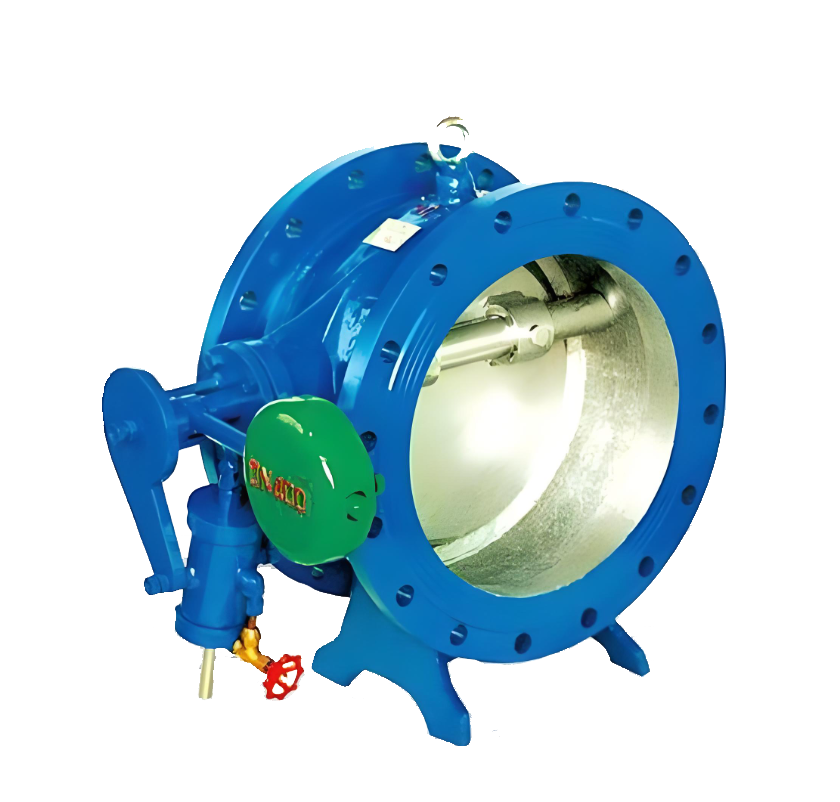
HH47X Buffered Butterfly Check Valve
- Model:HH47X-10/HH47X-16/HH47X-25/HH47X-10Q/HH47X-16Q/HH47X-25Q/HH47X-10C/HH47X-16C/HH47X-25C
- Specification:DN200-DN1400
- Temperature:≤80℃
- Medium:Water、sewage
- Pressure:PN10,PN16,PN25
- Connection method:flange
- Driving method:Automated
- Material:Ductile iron,Stainless steel,carbon steel


Add QR code to serve you!
- Product Overview
- Performance Data
- Size Weight
HH47X Buffered Butterfly Check Valve Overview
The HH47X buffer butterfly check valve is a key component in industrial fluid transport systems to prevent backflow of media. Its core is to achieve smooth opening and closing of the valve disc through a built-in hydraulic or elastic buffer mechanism, which can reduce the closing impact speed by 30%-50%, suppressing water hammer, reducing noise and sealing loss at the source. The sealing material is matched according to the characteristics of the media. When fully open, the flow resistance coefficient is as low as 0.5-1.2, resulting in significant energy savings.This valve is widely used in water supply and drainage, heating, chemical and industrial circulating water systems, and is especially suitable for scenarios where backflow prevention is required, such as the outlet end of a water pump. The selection should be determined based on the medium parameters, operating pressure and flow rate, and installation environment. The seal and lubrication should be checked regularly. Before maintenance, the medium must be cut off and the pressure released to ensure safety.
HH47X Buffer Butterfly Check Valve Product Image
HH47X Buffered Butterfly Check Valve features
1. Compact Structure: Utilizing a butterfly design, the valve body is small in size, lightweight, and occupies little space, facilitating installation and maintenance, and is especially suitable for piping systems with limited space.
2. Low Fluid Resistance: The streamlined design of the butterfly plate minimizes turbulence and cavitation during media flow, effectively reducing fluid resistance, minimizing energy loss, and improving system efficiency.
3. Slow-closing function: Equipped with a buffer mechanism (such as a hydraulic cylinder or spring), the valve can close slowly, effectively reducing the impact of water hammer on pipelines and equipment and protecting system safety.
4.Reliable sealing performance: Typically employs a double or triple eccentric sealing structure, resulting in low friction between the sealing surfaces. The sealing surfaces quickly disengage when opening and tightly seal when closing, effectively preventing media leakage and making it suitable for pipeline systems carrying various media.
5.Flexible Installation: Can be installed horizontally, vertically, or at an angle to adapt to different pipeline layout requirements. No special adjustments to the installation direction are required, facilitating engineering design and construction.6. Smooth Operation: The butterfly plate rotates flexibly, and the opening and closing process is smooth, without jamming, vibration, or noise, which is conducive to stable system operation and reduces maintenance costs.
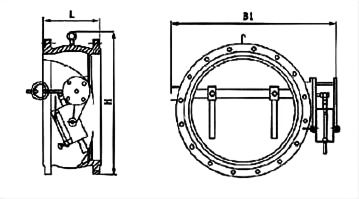
HH47X Buffer Butterfly Check Valve Structure Diagram
Parts Name Material List
| NO. | Name | Material |
| 3 | Body | casting steel |
| 2 | Disc | casting steel |
| 1 | Seal Ring | NBR、CR |
| Performance Specification | ||
| Nominal Pressure | 1.0/1.6/2.5 | MPa |
| Shell Test | 1.5/2.4/3.75 | |
| Seal Test | 1.1/1.76/2.75 | |
| Suitable Temp. | ≤80 | ℃ |
Dimensions Standard Requirements
1. The structural length of the valve shall conform to the standard GB/T12236.
2. The connecting flange shall conform to the standard GB/T17241.6
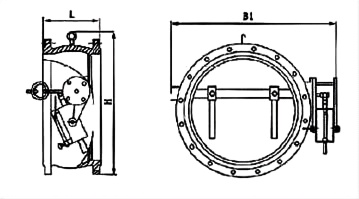
HH47X Buffer Butterfly Check Valve View Drawing
HH47X Buffer Butterfly Check Valve Dimensions Table
| DN(㎜) | 200 | 250 | 300 | 350 | 400 | 500 | 600 | 700 | 800 | 900 | 1000 | 1200 | 1400 |
| L | 230 | 250 | 270 | 290 | 310 | 350 | 390 | 430 | 470 | 510 | 550 | 630 | 710 |
| H | 550 | 630 | 690 | 780 | 860 | 980 | 1070 | 1220 | 1320 | 1430 | 1550 | 1800 | 1980 |
| B1 | 540 | 600 | 650 | 710 | 770 | 900 | 1090 | 1200 | 1320 | 1420 | 1550 | 1780 | 2000 |
-
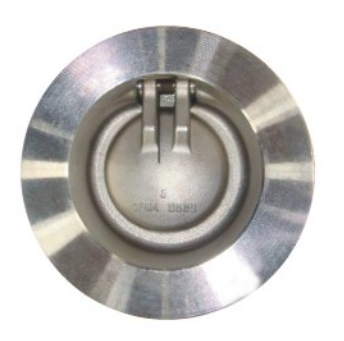 H74H Single Plate Wafer Check Valve(Long Type)
Model:
H74H-20C/H74H-40C/H74H-60C/H74H-100P/H74H-150PSpecification:
DN50-DN600Pressure:
PN20-PN150Material:
WCB、Stainless Steel -
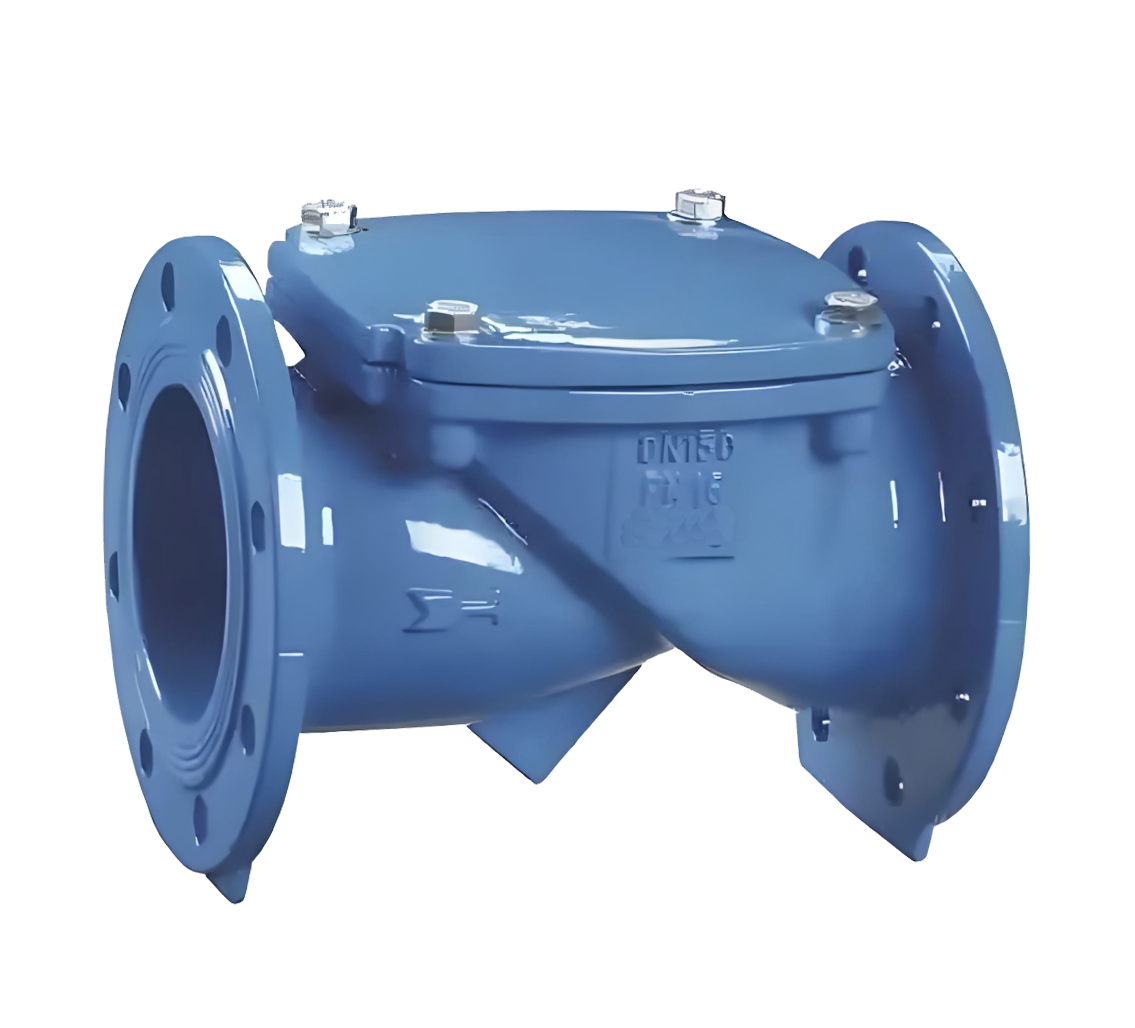 HC44X Swing Flex Check Valve
Model:
HC44X-10Q/HC44X-16Q/HC44X-25Q/HC44X-25C/HC44X-16C/HC44X-16P/HC44X-25PSpecification:
DN50-DN600Pressure:
PN10,PN16,PN25Material:
Ductile iron,cast iron,stainless steel -
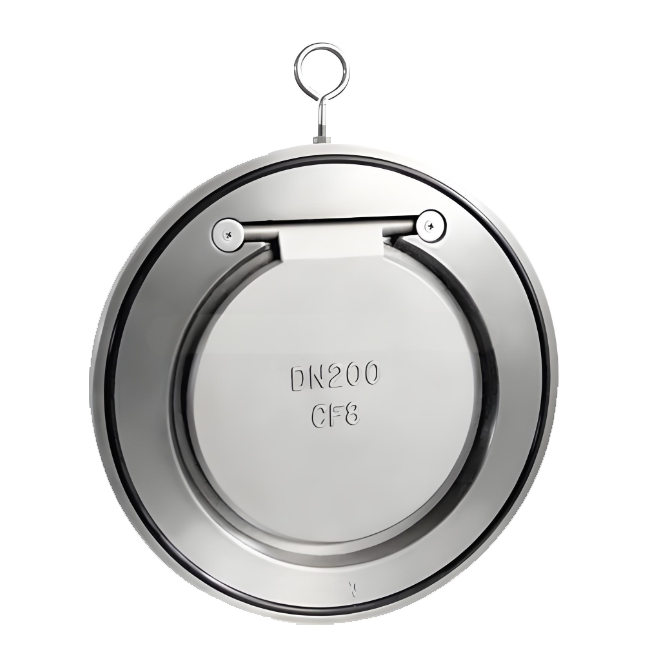 H74H Wafer Swing Check Valve
Model:
H74H-10C/H74H-16C/H74H-25C/H74H-40C/H74H-16P/H74H-25P/H74H-40PSpecification:
DN50-600Pressure:
PN10,PN16,PN25,PN40Material:
Carbon Steel, Stainless Steel

Complete Guide to Check Valve Selection and Installation: Detailed Explanation of Principles, Selection, and Key Construction Points Check valves, as crucial safety components in pipeline systems, are essential for preventing medium backflow and ensuring safe system operation. This article will provide you with a comprehensive guide to the selection and installation of check valves.
1. Operating Principle and Classification of Check Valves 1.1 What is a Check Valve?
Check valves, also known as one-way valves or non-return valves, belong to the category of automatic valves. Their working principle is to achieve opening and closing through the flow force of the medium itself. Their core function is to prevent the reverse flow of pipeline medium and ensure one-way flow.
1.2 Main application scenario: foot valve (a special type of check valve) at the water pump suction inlet
Various pipeline systems requiring unidirectional flow of medium
Industrial settings where accidents caused by medium backflow are to be prevented
II. Selection Criteria and Guidelines for Check Valves 2.1 Basic Selection Principles Medium Adaptability: Suitable for clean medium conditions, not recommended for pipelines containing solid particles or high viscosity media.
2.2 Selection of pipeline size (DN) based on pipeline size. Recommended valve types. Applicable pressure range: DN<50mm. Butterfly check valve, vertical lift check valve, diaphragm check valve. Low-pressure environment: 50mm
Advantages: Effectively eliminates the water hammer phenomenon
Limitations: Subject to temperature and pressure constraints, suitable for low-pressure and normal-temperature pipelines
Applicable scenario: Water supply pipelines prone to water hammer
Slow-closing check valve:
Slow-closing swing check valve
Slow-closing butterfly check valve
Applicable scenario: pipeline systems that require minimal or no water hammer impact when shut down
III. Installation specifications and construction requirements for check valves 3.1 Preparatory work before installation Appearance inspection:
Check the valve nameplate information to ensure compliance with the GB 12220 "General Valve Marking" standard
Check the integrity of the valve and confirm that it is undamaged
Pressure test requirements:
If the working pressure exceeds 1.0 MPa or the main pipe shut-off valve is involved, a pressure test must be conducted
Strength test: Nominal pressure × 1.5, duration ≥ 5 minutes, no leakage is considered as qualified
Tightness test: nominal pressure × 1.1, determine the duration according to GB 50243 standard
3.2 Installation location and direction: Strictly follow the design drawings to determine the location, height, and inlet and outlet directions
Flow direction indicator: Ensure that the flow direction of the medium is completely consistent with the direction indicated by the arrow on the valve body
Pipe support:
It is prohibited to let the check valve bear the weight of the pipeline
Large check valves must be equipped with independent support structures
Avoid direct impact of piping pressure on the valve
3.3 Lift check valves are required for specific types of installations:
Vertical flap type: It must be installed on a vertical pipeline
Horizontal flap type: It must be installed on a horizontal pipeline
Swing check valve:
Ensure that the valve disc's rotating shaft is in a horizontal position during installation
Special attention should be paid to the flow direction of the medium during inclined installation
IV. Common Installation Errors and Precautions 4.1 Example of Incorrect Installation: Installing a Vertical Lift Check Valve on a Horizontal Pipe
The valve flow direction is reversed
Large valves have no independent support
Pressure testing was not conducted according to specifications
4.2 The selection and installation location of check valves should be considered during the design phase of the professional advice system
Provide complete operating condition parameters to the supplier during procurement to obtain professional selection advice
For complex systems, it is recommended to consult a professional valve engineer
Conduct regular maintenance and inspection to ensure the check valve operates in normal condition
5. Maintenance points: Regularly check whether the valve can be opened and closed flexibly
Monitor for abnormal sounds, such as water hammer impact
Check the sealing performance to prevent internal leakage
Lubricate the moving parts to ensure normal operation
The correct selection and installation of check valves are crucial for ensuring the safe operation of pipeline systems. Following the selection guidelines and installation specifications provided in this article can prevent various accidents caused by medium backflow, extend the service life of valves, and reduce maintenance costs.
In practical applications, it is recommended to consider specific engineering requirements and medium characteristics, and if necessary, consult professional valve technicians to ensure the optimization of the selection and installation plan.

Address:No. 1, Linxia Road, Sanqiao Industrial Zone, Oubei Sub-district, Yongjia County, Zhejiang Province| Switchboard:0577-67198981| mobile:+8613388552747| Email:sales@shanliuvalve.com|
COPYRIGHT © Zhejiang Shanliu Valve Technology Co., Ltd. Main Business: Water Valve Industrial valve|
浙ICP备2026020749号